Alcott Studio
A Mac writing studio that connects manuscripts, story continuity and reviewable AI revisions.
Alcott Studio is a native macOS fiction-writing prototype. Chapters and worldbuilding live as ordinary files in the author's project folder, while a chapter workspace brings planning, context, AI-assisted drafts and revision history together.
The focus is reviewable collaboration: proposed prose and changes to the story world are inspected before acceptance, with checkpoints for recovery. Perspective-aware context distinguishes what is true in the world from what a character or reader knows. The private application is still in development.
Highlights
- Native Mac manuscript editing
- Context that respects character knowledge
- Reviewable candidates and reversible checkpoints
In action
The manuscript has a home
Writing a longer piece of fiction produces more than a sequence of chapters. There are characters, places, facts, plans and earlier decisions to keep track of. Alcott Studio brings that material into a native Mac workspace, with the manuscript itself remaining the centre of the experience.
The project folder contains ordinary Markdown and worldbuilding files. The application reads and edits that material rather than making the story depend entirely on an opaque document format. SwiftUI provides the surrounding workspace, while an AppKit and TextKit editor handles the manuscript. A Rust sidecar supports analysis of the project.
Context has a perspective
An AI collaborator needs more than a large collection of notes. It needs the material relevant to the chapter and the limits of the perspective being written. A fact can be true in the story world without being known to the current character, or without having been revealed to the reader yet.
Alcott's grounding model treats those distinctions as part of the writing problem. Planning and context selection happen before a candidate is generated. The aim is to make a chapter's supporting knowledge explicit, so an assistant can work with continuity without casually exposing information that belongs later in the story.
Drafts arrive for review
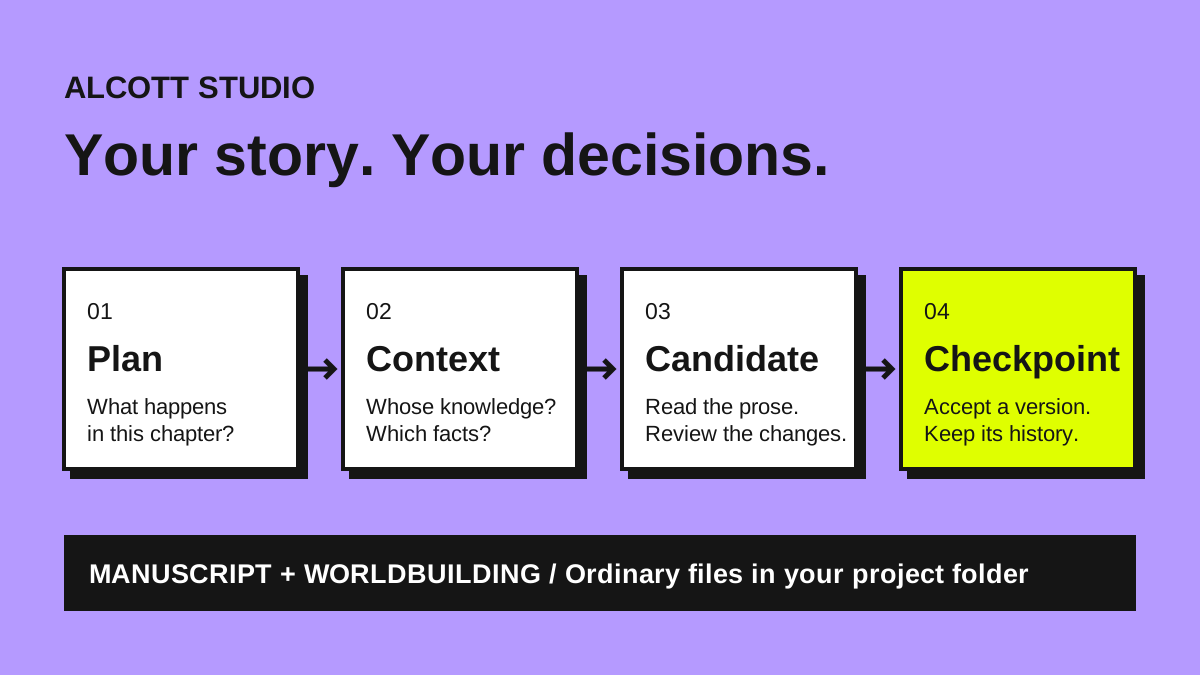
The Chapter Room brings together the plan, supporting context, candidate prose, checks and critique. A generated chapter is a candidate to inspect and revise. Changes to world knowledge are also proposals, with a review step before they are accepted into the project.
That makes the collaboration visible at two levels: what changed on the page, and what those words imply about the fictional world. The implementation includes candidate editing, context inspection, canon proposals and an acceptance workflow. The author remains responsible for deciding what becomes part of the manuscript and its continuity.
A decision can be reversed
Checkpoints and history make acceptance a recorded decision rather than an irreversible replacement. Recovery belongs beside generation: being able to revisit an earlier state matters when a new direction changes the meaning of a chapter or introduces facts that no longer fit.
Development began in August 2026. This remains a private application prototype, with implemented editing and review paths but no public download. The illustration explains the chapter workflow without exposing private manuscripts. The interesting question is how to make AI useful inside a sustained writing practice while keeping the work understandable and under the author's control.