Anonymous Questions
A room for the questions people might not ask out loud.
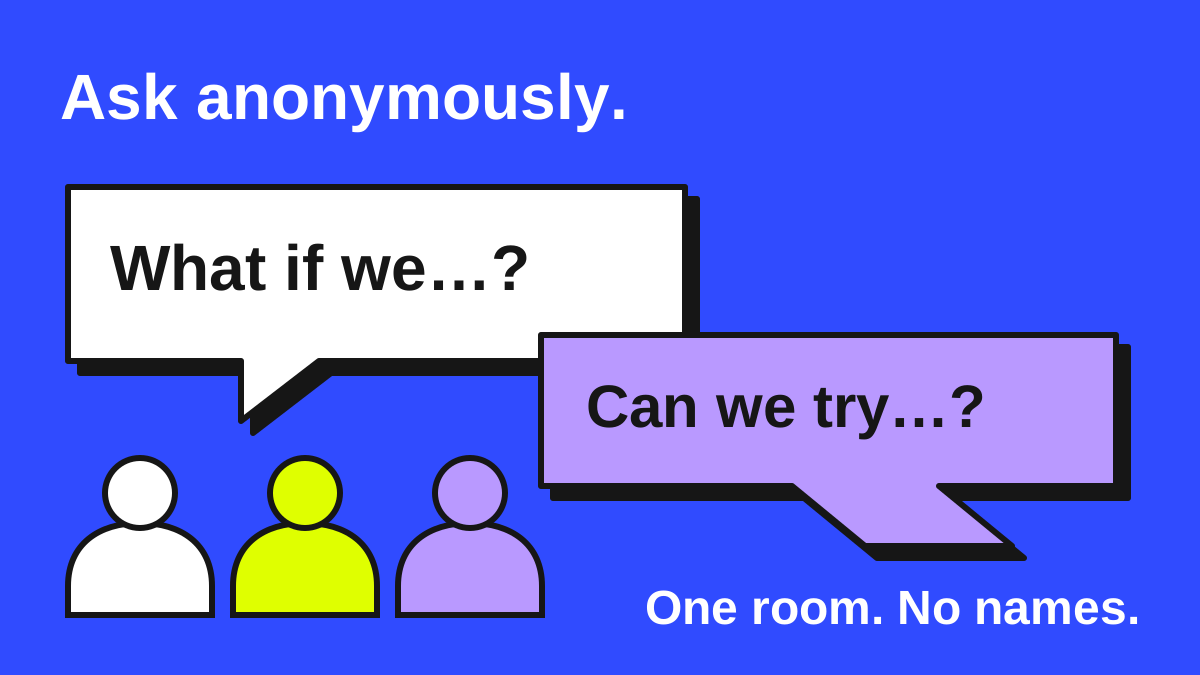
Create a room, share its link, and let people ask questions without adding a name. Anonymous Questions is useful for team meetings and other conversations where people may hesitate to speak up.
Questions travel directly between browsers and stay in memory, so the host keeps their tab open. Optional AI runs on the device and suggests more neutral wording for the author to review before sending.
Highlights
- Share a room for unnamed questions
- Send questions directly between browsers
- Review optional on-device wording suggestions
A room for difficult questions
A meeting can have plenty of questions and very few volunteers. Asking about a change in direction, a decision from leadership, or a concern shared by the team can feel different when your name sits beside the question. Anon gives the organiser a shared room where the question can be considered on its own.
The organiser shares a link, people join in their browsers, and submitted questions appear in the conversation. There is no account to create or profile to complete. That short path matters during a live meeting: people can arrive, ask, and return their attention to the discussion.
Temporary by design
The browsers connect through WebRTC data channels. A public signaling service helps establish the connection; question content then travels between peers and is held in browser memory. The host distributes questions to the other participants and sends the existing list to people who join later.
Keeping the host's tab open is part of the arrangement. There is no saved question database to reopen after the room ends. This makes Anon suited to a shared moment, with an explicit boundary: connection metadata and details in the question can still identify somebody. Removing a name field cannot guarantee anonymity.
Help with wording, under your control
An optional Qwen model suggests a more neutral version of a draft. It runs in a browser worker on the person's device. Enabling it downloads about 580 MB of model files and requires supported WebGPU hardware, so ordinary questions remain available without loading the model.
The important interaction is the review step. A suggestion appears separately, the original stays editable, and sharing or changing the draft cancels pending work. Checks reject some altered numbers, missing terms, and incomplete output, but the person still decides whether the meaning survived. The project brings peer communication and local AI together around that small, deliberate act of consent.
Related writing

Anon: Peer-to-Peer All-Hands Q&A
Peer-to-peer all-hands Q&A with questions kept in browser memory and an optional local AI suggestion that you review and accept before sending.

Picking a Language Model Small Enough to Live on Your Phone
Benchmarking small language models to run on a phone: why accuracy plateaus at 3-4B, why RAG hurt, and how a deterministic calculator beat the LLM.