Date Calculator
Add and subtract time without opening a spreadsheet.
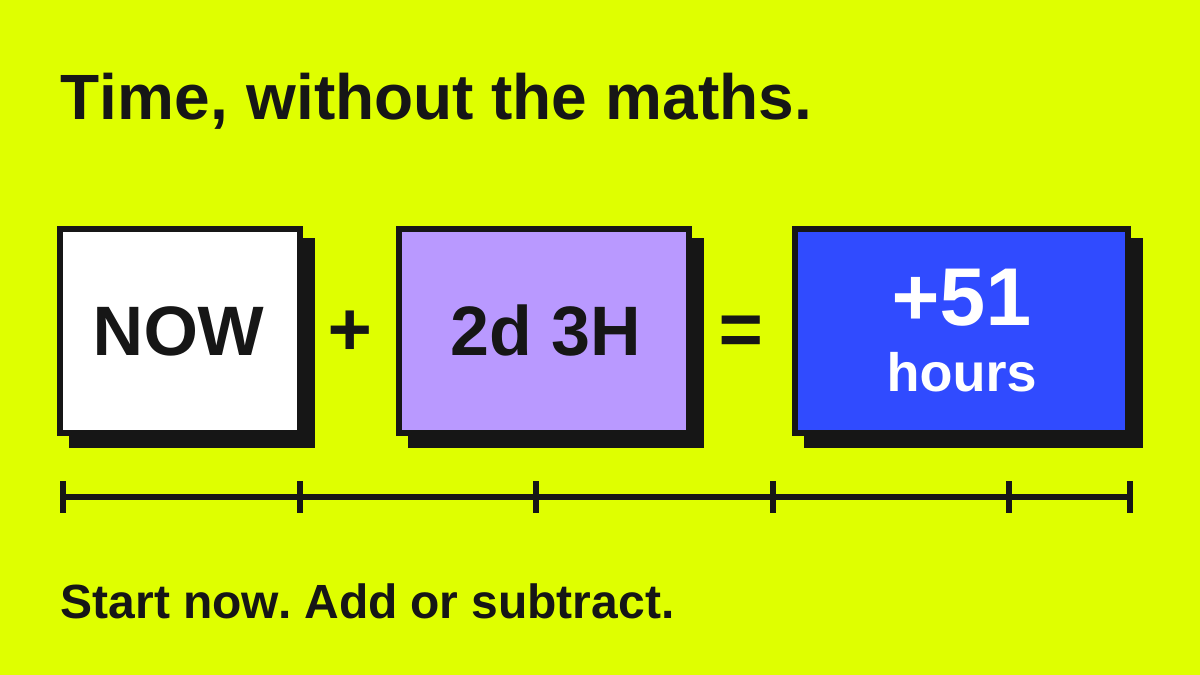
Find a date before or after right now. Type 2d 3H to move two days and three hours ahead, or -2w to go back two weeks. The result appears in your local time zone.
Adjustments use fixed durations: a month is 30 days and a year is 365 days. A short syntax guide and ready-made examples make it easy to add or subtract time without opening a spreadsheet.
Highlights
- Add and subtract time
- Use short units such as 2d or -2w
- Run directly in the browser
A small question about time
Sometimes the whole task is to work out what date falls two weeks from now, or when something happened three days ago. Date Calculator keeps that task small: one input, a readable result, and a guide close enough to use without leaving the page.
Enter an adjustment and the result changes as you type. A minus sign moves backwards, and spaces combine several adjustments. The example 2d 3H adds two days and three hours to the current moment. The output includes a date and time in your local time zone, so the calculation ends in something immediately readable.
A language that fits in one line
The input uses signed whole numbers followed by short units. Weeks and days use w and d; hours use uppercase H. The distinction between lowercase m for months and uppercase M for minutes is deliberate, with min also accepted for minutes. The syntax table makes those details visible beside examples.
Behind the input, the parser splits the line into adjustments and adds their durations to a timestamp. Unrecognised adjustments are ignored. That behaviour makes the guide important: this is a compact expression you can learn and reuse, and the visible result lets you check what the recognised parts produced.
Duration is the rule
The calculation uses fixed lengths: a month means 30 days, a year means 365 days, and a day means 24 hours. Those choices keep the arithmetic simple and predictable. They also mean that moving one month from today may land differently from choosing the same day in the next calendar month.
The project is useful within that clearly stated scope. It brings a repeated calculation into a small browser interface, puts examples beside the input, and explains the rule that affects the answer. Its size is part of the point: opening the tool should take less effort than the arithmetic it replaces.