Seasonal Skies
A Minecraft server ecosystem: player islands, shared progression, timed supply drops, and a world that remembers its rules.
Seasonal Skies was a Minecraft server project we built in 2019, in the vein of CosmicPVP. I was the developer; my partner brought the community and understood the game.
Players built islands, invited others, earned experience and unlocked equipment. Java plugins connected that progression to supply drops, currencies, rewards and shared-world events. Island valuation and persistent timers had to work while players kept building and exploring.
Highlights
- Islands with membership, ranks, and progression
- World snapshots for island valuation
- Supply drops, currencies, and persistent ore timers
In action
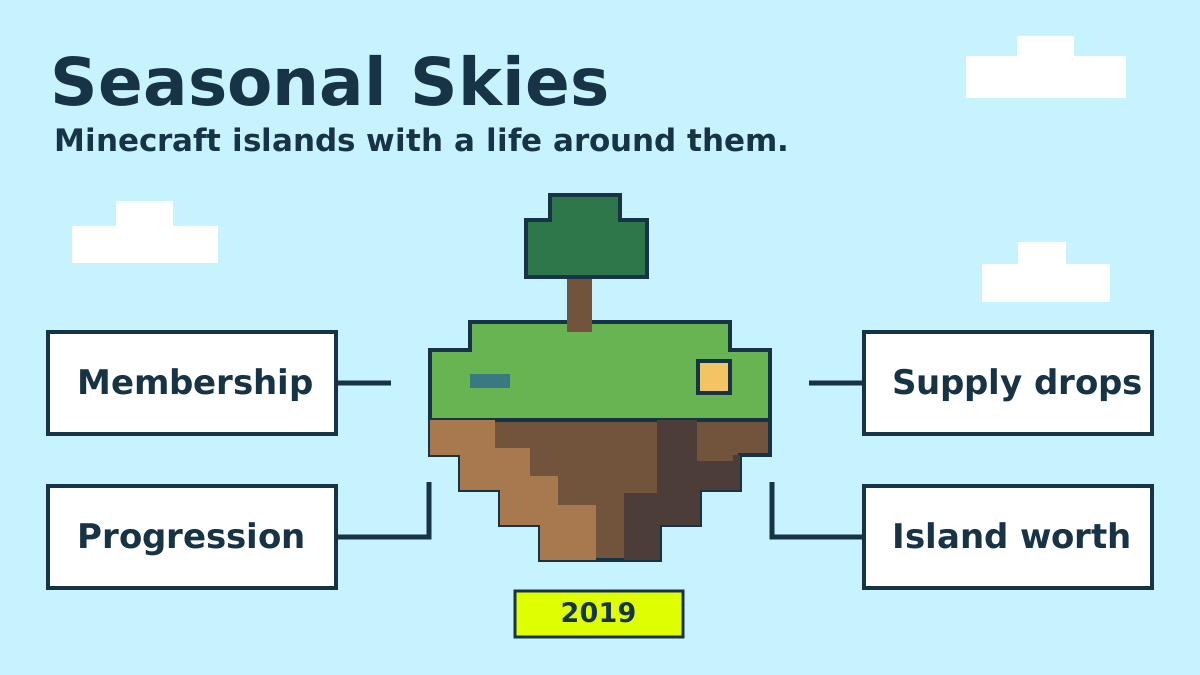
A small world with shared rules
An island server gives players a small place to build and a larger set of goals to grow towards. Seasonal Skies generated islands from saved schematics, then added invitations, ranks, leadership transfer, chat, and warps. An island belonged to a group of people with permissions, rather than being only a patch of blocks.
Experience and levels connected that building to progression. Tools, weapons, and armour could be restricted by level, while leaderboards compared island wealth and progress. The rules also distinguished naturally obtained rewards from shortcuts: placed blocks and immature crops were excluded from relevant experience gains.
Count blocks without stopping the world
Island worth required inspecting the blocks across a player's land, including different types of mob spawner. A direct scan of a large, changing world could compete with the server's work of handling movement, combat, and block events. The implementation broke that problem into two stages.
Chunk snapshots were captured in batches on server ticks. The valuation then scanned those snapshots asynchronously, adding up configured block values. The game-facing world was sampled in the appropriate context, while the heavier counting work used those samples. It is a concrete example of separating access to live state from computation over a stable copy.
Give players reasons to venture out
Timed supply drops used weighted crate selection, configured regions, falling blocks, and cleanup. Crates exposed rewards and previews, while other plugins handled currencies and shared-world events. The Stars currency could be withdrawn as an inventory note and redeemed again by another interaction, connecting a balance to an object in the game.
The Warzone plugin tracked ore respawn timers and saved pending respawns. Unloaded chunks needed attention too, because the world can stop being present in memory before its timer finishes. These systems made persistence and timing part of the game design, rather than treating every player action as an isolated command.
The systems behind the server
A collection of Java plugins connected island membership, ranks, progression, currencies and shared-world events. Experience controlled access to equipment, and currencies connected rewards to the wider economy.
That meant carrying game rules through the implementation: honouring cancelled block-break events, handling mob experience, enforcing tool restrictions and truces, and keeping shared events and respawn timers consistent. The work spanned the whole server, from individual player actions to the state of the world.