Spoticover
Geometric Spotify playlist covers, generated from a name and a few visual rules.
Spoticover started with my own Spotify library. I liked making colourful geometric playlist covers, but doing every playlist by hand took too long. The browser tool turned that style into a repeatable generator, using playlist names as seeds and visual constraints to keep the results coherent.
The React and Canvas implementation included editable shapes and colours, PNG downloads, and a Spotify connection for selecting playlists and uploading artwork. The hosted app was retired in October 2026. Its covers and implementation are preserved here as an archived personal project.
Highlights
- Repeatable covers from playlist names
- Geometric artwork drawn in the browser
- PNG export and Spotify cover uploads
In action
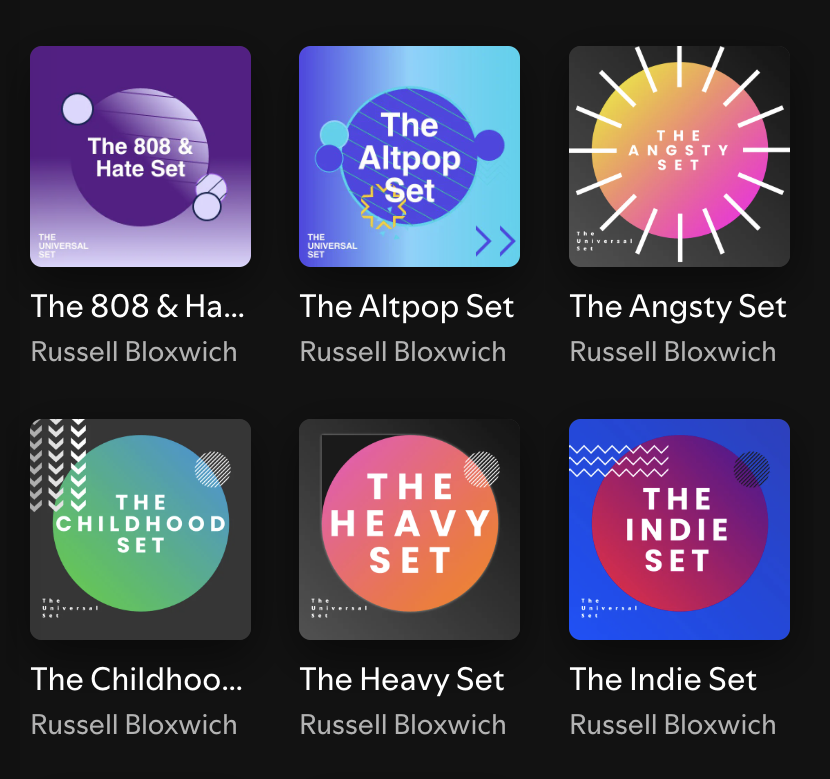
A visual identity for my playlists
My music library had more playlists than I wanted to design covers for. I had been using an online editor to assemble shapes manually, and liked the results enough to want that style across the collection. Spoticover was a way to keep the personal visual identity while removing most of the repetitive work.
The output is abstract artwork built around a playlist title: a large circle, smaller shapes, patterns, gradients and text. A cover can stand on its own, while a whole collection still looks related. The image above shows covers I actually used, rather than a proposed product mockup.
Randomness with a point of view
Drawing random shapes is easy. Getting a useful cover from them is a different problem. I encoded preferences for colour harmonies, shade ranges, position and how often decorative elements should appear. Those rules give the generator room to surprise me without filling every cover with competing features.
A text seed makes a design reproducible. The app converts a playlist name into a numeric seed, then uses it to choose the visual configuration. That means a name can produce its own cover, and a design can be revisited without saving every individual decision made by the generator.
From the canvas to Spotify
React holds the editable configuration and an HTML canvas draws the artwork. The interface exposes controls for colours, text, canvas size and the geometric elements. For the task I cared about, the quick path was entering a name, generating a cover and keeping a result I liked.
The implementation also connects to Spotify through an OAuth flow. Selecting a playlist supplies its name as the seed and title. Artwork can be downloaded as a PNG, or converted to a JPEG for the playlist-cover upload endpoint. The integration connected the generator to the library that prompted the project in the first place.
Useful without becoming a business
I used AI heavily while building the app, and wrote about both the useful acceleration and the imperfect controls it left behind. Some fine-tuning controls did not behave as intended, and large playlist collections exposed loading problems. The name-driven generation still solved my original need, so the project did not have to become a polished commercial editor to be worthwhile.
The hosted generator was retired in October 2026. What remains is a clear personal use case, a collection of real outputs and a useful example of constrained procedural design. The linked article goes further into the original rules and the development experience.
