VEWEN
Source-linked authoring for technology transfer. Retired because selling to budget-constrained universities was too difficult.
Technology transfer teams help turn research into partnerships, licences, and new businesses. VEWEN was an authoring workspace for that work: organise the source material, capture a specialist's judgment, and use both when drafting evaluations, business plans, and licensing documents.
I led product and engineering, working with people who know the domain. We built a rich document editor, knowledge-capture flows, AI-assisted drafting and references that travel with the text. We stopped the project because the economics did not work: selling to budget-constrained universities was too difficult to support the business.
Highlights
- Capture and reuse specialist knowledge
- Keep source references with generated text
- Review suggested changes in a document editor
In action
Writing for a specialist domain
A technology transfer office connects research with the people who might develop, fund, or license it. Its documents need to communicate the opportunity and the evidence behind it. An evaluation, market assessment, or licensing memo brings together source material and judgment that may otherwise sit with one experienced person.
VEWEN started with that work. Projects collect files, documents, and relevant knowledge in one place. The authoring workflow gives the team an editor and an assistant, while keeping the specialist responsible for what the document ultimately says. I led its product and engineering in partnership with people who brought the technology transfer experience.
Capture the reasoning as well as the answer
Expert knowledge is not always a document ready to upload. It can be a framework, a useful question, or the reason a writer changes a sentence. VEWEN's capture flow asks follow-up questions and combines the answers with existing knowledge, producing material that can be reused in later authoring work.
The implementation separates reasoning guidance from authoring guidance. That distinction gives the system a way to represent both how an issue should be assessed and how the result should be expressed. Tags, descriptions, and suggested tools help organise the captured knowledge, so the library can serve another project rather than disappear into one chat.
A citation has to survive an edit
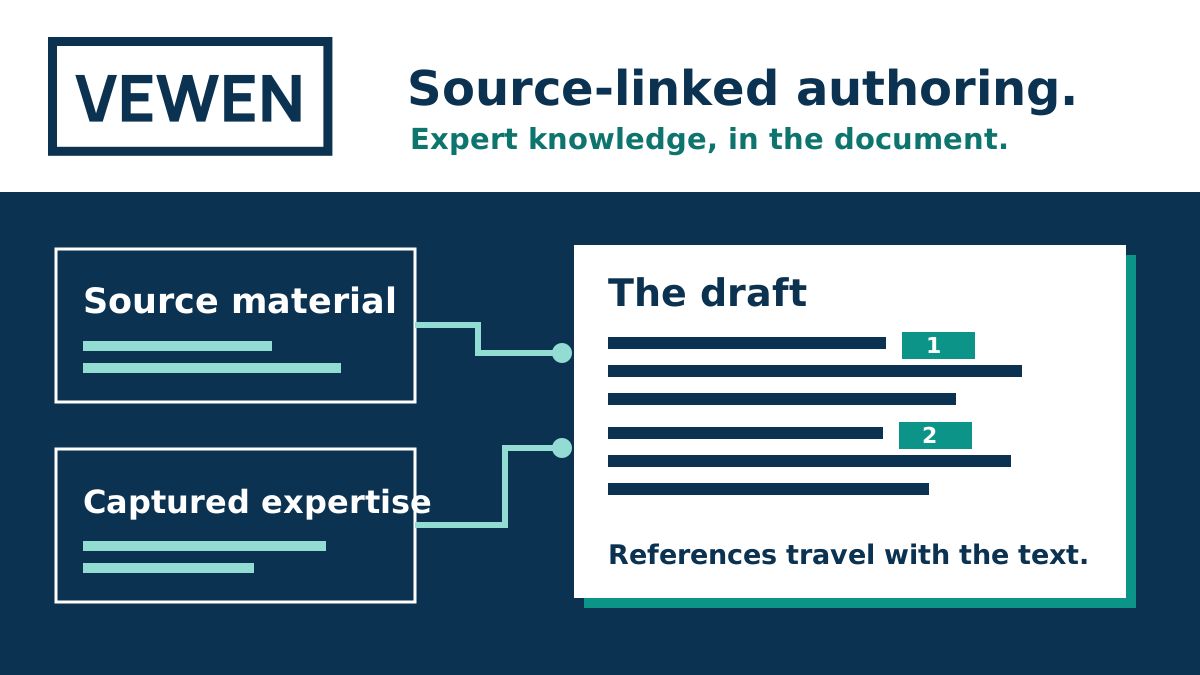
A reference needs more than an identifier if a writer is going to inspect it. The document pipeline carries source metadata with the reference: a file or web title, URL, author information, page number, and relevant context when available. The editor can then show the source alongside the text it informed.
That metadata is added before the generated update enters the shared document. The document keeps the information needed to render its references after the edit is applied. It avoids depending on a separate chat result to explain a paragraph that has already moved into the draft.
Bring suggestions into the document
The React application uses a rich text editor with shared document state, source annotations, document settings, and export controls. Suggested insertions, deletions, and replacements have to resolve to the right part of that document before they can become useful changes. References remain part of the editing workflow rather than a list attached after generation.
The broader system includes source selection, knowledge capture, document generation, and target-list research. Those capabilities share the same product concern: the person doing the work needs enough context to assess the result. The application remains private. We retired the product because selling to budget-constrained universities was too difficult and the economics did not support continuing. The illustration explains the authoring model without exposing client documents.