Vibe CLI
Run a fictional AI startup. Build a tool stack, chase contracts, and keep token production ahead of costs.
Vibe CLI is a terminal-style browser game about running a fictional AI startup. Start with a bedroom and one coding tool, then arrange tools, hardware, employees, and offices on a growing grid. Neighbouring items change how the stack performs.
Accept client contracts, advance the working day, and weigh output against quality and running costs. The game combines a deckbuilder's tool combinations with a roguelite's repeatable startup runs. It remains a private prototype, with locally generated events and browser saves rather than a public release.
Highlights
- A spatial stack of AI tools and office upgrades
- Contracts, work tokens, deadlines, and running costs
- Terminal-style panels, typed commands, and local saves
In action
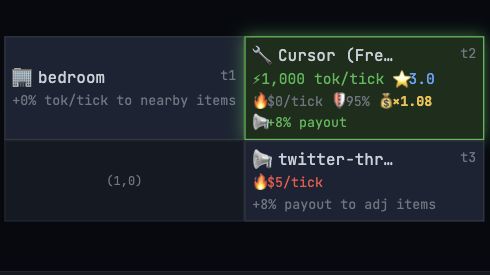
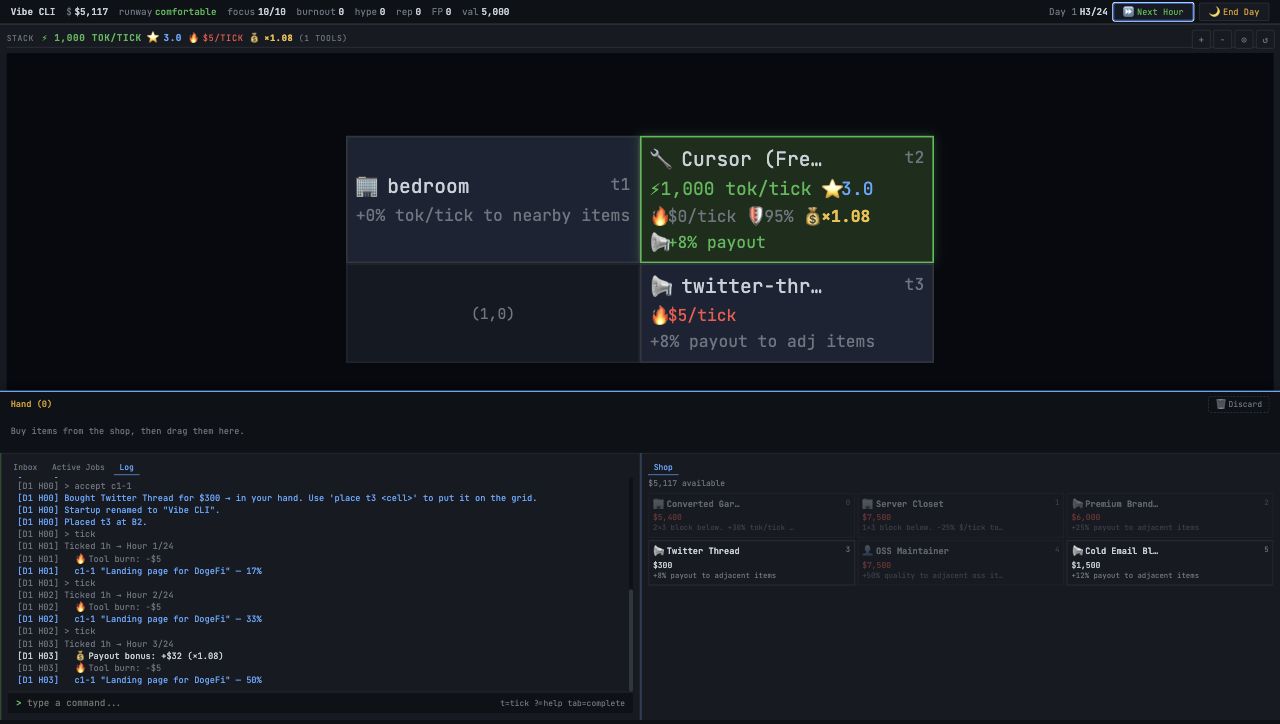
The AI startup as a game
The premise takes the language of AI development literally. Your coding tools become items you can collect and combine. Their output becomes work tokens, client projects become contracts, and the startup has cash, reputation, hype, burnout, and a valuation to keep track of. The names and numbers belong to a satirical game, rather than a realistic comparison of AI products.
You begin with one coding tool beside a bedroom office. The next decision might be accepting a manageable job, buying another tool, or keeping enough cash to survive the day's costs. Growing the business gives you more possibilities, but also more competing demands. It is a startup-management game with the combinations and repeated runs of a deckbuilder roguelite.
The stack is a board
The tool stack is a physical arrangement on a grid. Tools, hardware, employees, subscriptions, and other upgrades occupy cells, and their neighbours can change their bonuses. That turns choosing a tool into two decisions: whether it belongs in the business, and where it belongs on the board.
Offices add space in different shapes. Expanding to the right creates different opportunities from opening a row below or adding cells around an existing office. Moving an office can leave items without a valid cell, returning them to your hand. Placement, expansion, and rearrangement become part of the strategy instead of another list of purchases.
Output is not profit
The interface distinguishes the tokens produced by your stack from the money available to spend. A contract asks for work with a required quality and a deadline. Tools contribute throughput and quality, while their running costs reduce the cash you have left. A faster stack can finish work sooner and still be a bad purchase if you cannot support it.
Each tick advances the working day by an hour. At the end of the day, salaries, subscriptions, rent, research, and technical-debt costs are settled. Focus, burnout, reputation, and hype add pressures beyond raw production. The interesting decisions come from fitting those demands together: which work to accept, which combinations to build, and when to stop expanding.
A terminal you can play
A dark monospace interface keeps the board, contracts, shop, and startup statistics in the same workspace. Items can be moved around the board, while the Log tab exposes a command prompt with history and completion. Commands such as accept, buy, place, and tick describe the same actions available through the surrounding interface.
The React interface reads a typed game state, with engine modules handling contracts, time, placement, costs, and events. Seeded local content generates the market and fictional event timeline. Browser storage keeps the current run between visits, so the prototype does not need an account or an external AI service to produce a day of play.
The current version is a private prototype. The screenshots show a run through its local engine, with simulated clients and costs.