Webscav
A worldwide scavenger hunt for makers, tinkerers, and curious friends.
One list, one deadline, and a team of people willing to try something strange. Webscav brings building, performing, and exploring into a worldwide team scavenger hunt.
The first hunt is taking shape. The public site offers a taste of the challenges and an interest list for people who want to join in.
Highlights
- Creative team challenges
- A shared list and deadline
- First-hunt interest list
In action
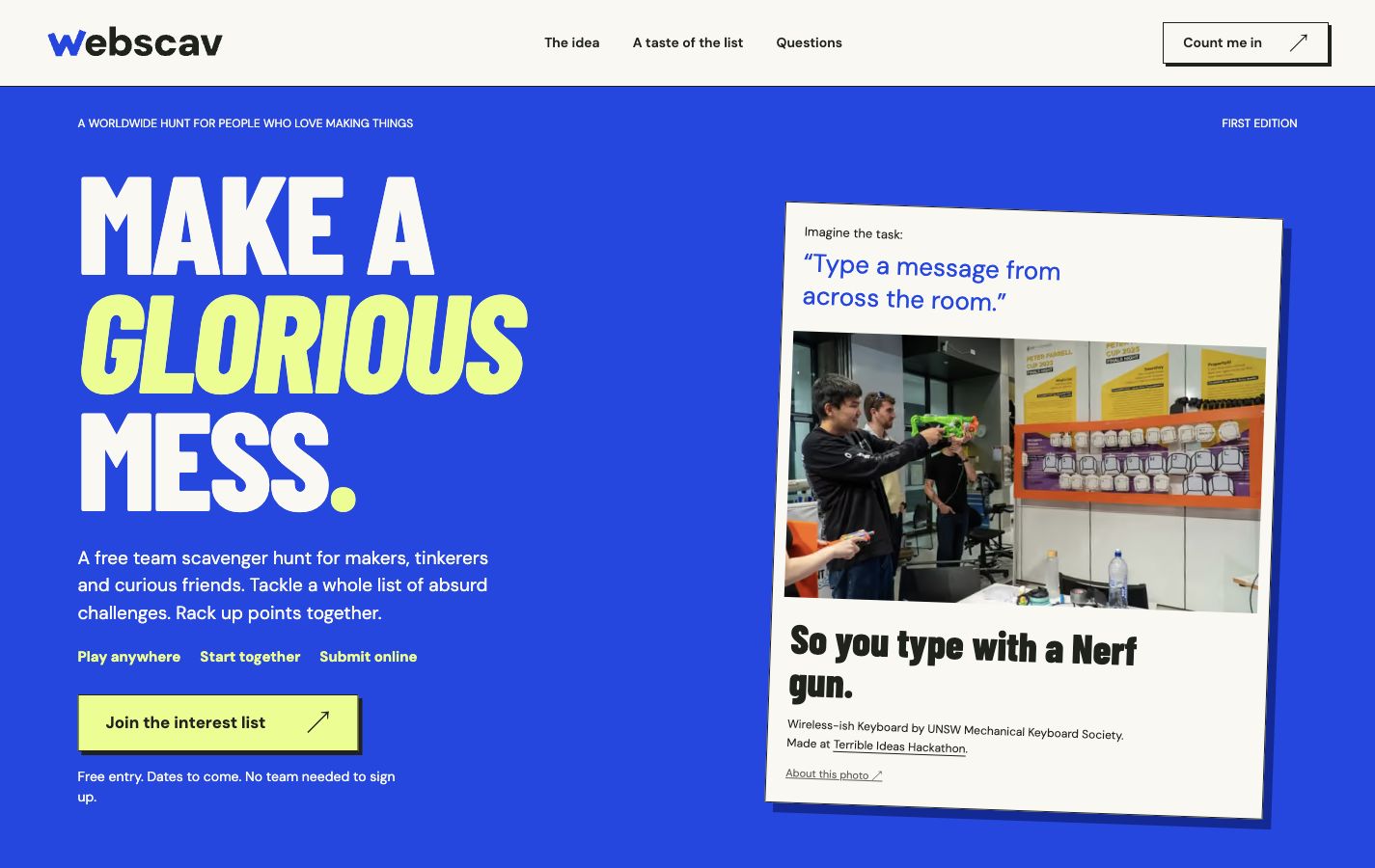
One list, many ways in
The interesting part of a scavenger hunt is deciding what your team can pull off. Webscav’s format gives every team the same challenge list and deadline, then leaves the choices to them. Some people might spend the day building something elaborate while others collect smaller wins. Finding the right mix is part of the competition.
The list is being designed to bring together engineering, art, performance, exploration, and organising. Someone who can plan a shoot or turn a set of instructions into a performance has a useful part to play alongside the person who wants to build the mechanism. Entry is free, with an emphasis on tasks that can use everyday materials.
A clear brief, an unexpected answer
A good task tells you what must happen without dictating how to do it. The public sampler includes possibilities such as making an absurdly complicated household machine, playing instruments built from discarded packaging, or turning a local landmark into a costume. These are illustrative tasks, rather than the final event list.
The evidence matters as much as the premise. A machine needs to be shown doing its job; a performance needs a recording that lets a judge understand it. That leaves room for ingenuity while giving teams a concrete target. Points come from meeting the brief, rather than spending the most money or producing the most polished claim.
Show the attempt
The website uses real work to make the invitation tangible. Its Nerf-operated keyboard was made by UNSW Mechanical Keyboard Society at Terrible Ideas Hackathon, and remains credited to them. It illustrates the kind of unlikely construction the hunt could inspire; it is not a past Webscav submission.
That distinction carries through to the event rules. Teams will submit evidence of what they actually made or did. AI can help with planning or troubleshooting, but generated media cannot stand in for an action happening. The attempt, its contributors, and its evidence need to stay together.
Building the first hunt
The public site is built with Astro, with interactive React components for the challenge sampler, questions, and signup. EnoughUI supplies the interface foundations, while Webscav’s own typography, wordmark, and colour palette give the invitation its character.
The first hunt is still taking shape. The site explains the format and collects interest; it does not take competition registrations yet. Dates, duration, and team sizes will be announced before registration opens. You can join the interest list without already having a team.
Related writing

TerribleHack 2025
Running TerribleHack 2025 solo for the first time: print disasters, 17 gloriously terrible projects, and a denim trophy the winners tear apart.

TerribleHack 2024
Co-organising TerribleHack 2024 as Zac hands over the reins: destroy-your-project challenges, ice-cutlery dinners, and what makes a great maker event.

Mixer Mayhem
Building a crowd-controlled robotic bartender at TerribleHack 2023: peristaltic pumps, a WebSocket god-client deploy pattern, and a force-push disaster.